
Boosting European Competitiveness: Where to Go from Here?
October 17, 2017
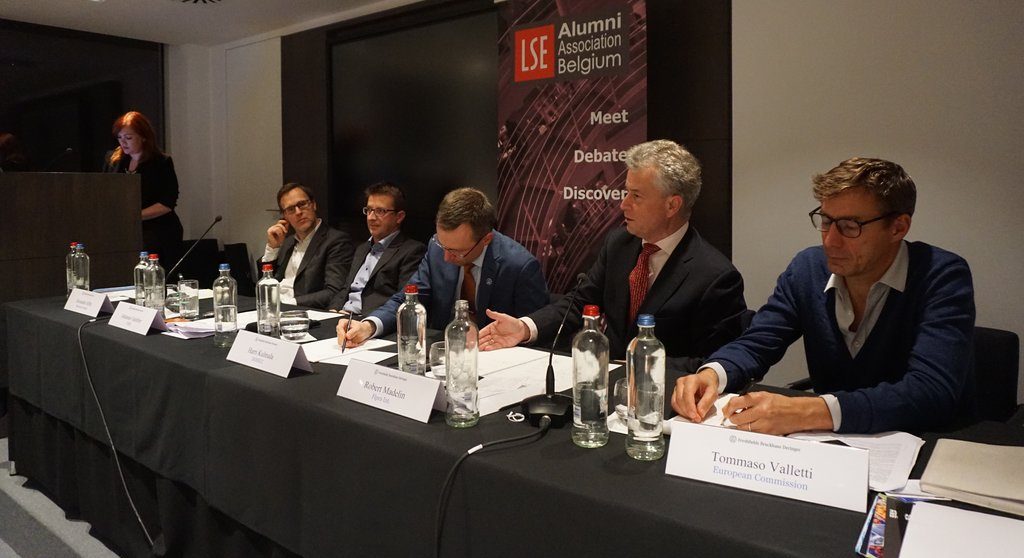
On Wednesday, 11 October, the LSE Alumni Association Belgium in collaboration with the Future Circular Collider (FCC) Study of CERN, organised a debate on the role that innovation plays in the competitiveness of the European economy and what the different actors involved, from policymakers to scientists, can do to strengthen it.
Some of key players in the sector took part in the discussion: Alexandre Affre, Director of Industrial Affairs at Business Europe, Johannes Gutleber, Senior Scientist at the Future Circular Collider (FCC) Study at CERN, Harri Kulmala, CEO of DIMECC Ltd. and member of the European Commission’s High-Level Group on maximising the impact of EU research and innovation programmes, Robert Madelin, Fipra International's Chairman and former Director General of DG CONNECT at the European Commission, and Tommaso Valletti, LSE alumnus (MSc and PhD in Economics), Chief Competition Economist at the EC and Professor of Economics at Imperial College London. The discussion was chaired by Jennifer Baker, a senior journalist specialising in EU tech policy.
To open the debate, Ms Baker asked the panellists if innovation is suffering from a lack of investment. There was consensus that investment always plays a role, a position particularly favoured by Dr Gutleber: “you can never overinvest in education”.
The discussion then turned to the need to find new ways to present the visions behind innovative technologies to investors, who are often hesitant to take risks as they work within existing frameworks. Mr Kulmala used the example of ports, which might not be needed in future if drone technology becomes more advanced.
This idea is connected to the way we regulate innovation, as the kind of society that we want to build, according to Prof Valletti, also shows the type of innovation that we want to implement. On the other hand, Mr Madelin argued, steering the market with rules makes it inconvenient for companies to pursue change. Mr Affre suggested that a network connecting companies and scientists would help to cross the “valley of death”, allowing research prototypes to become innovative products available on the market.
The event concluded with a Q&A session and a dinner that gave the opportunity to the panellists and the audience to continue the discussion over a glass of wine.
We would like to thank the Future Circular Collider (FCC) Study of CERN for their collaboration, the speakers and the moderator for their participation, the law firm Freshfields Bruckhaus Deringer for their warm hospitality and all the LSE Alumni and friends for attending and taking part in the lively discussion.
To see more photos from the event, please visit our Facebook page.