
Review: LSE AAB discusses the ‘Confidence Culture’ on International Women’s Day 2022
March 10, 2022
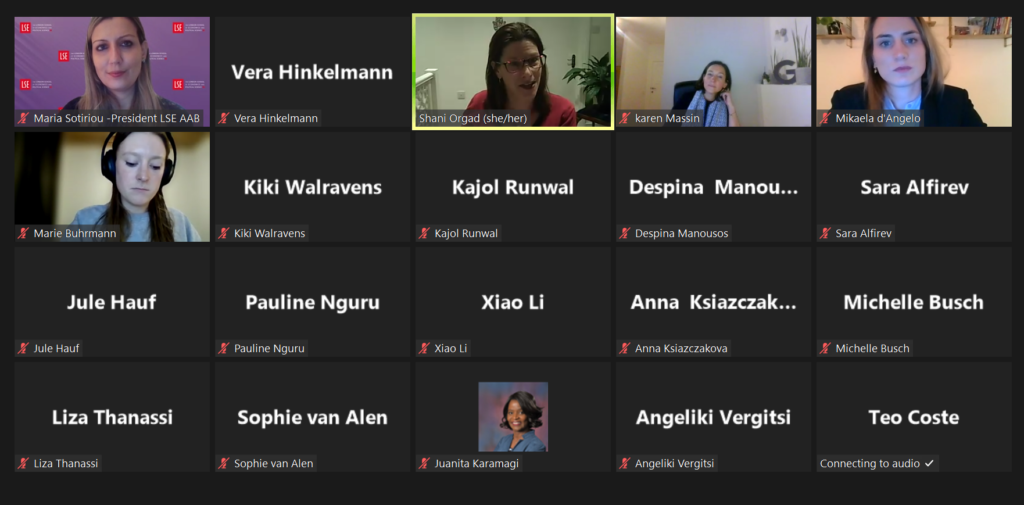
To celebrate the International Women’s Day, on 8 March 2022 we invited our alumni to discuss the popular concept of ‘Confidence Culture’ with Karen Massin, Head of Government Affairs and Public Policy at Google and Shani Orgad, Professor in the Department of Media and Communications at LSE, who has recently published a book on the topic together with Rosalind Gill.
Our distinguished speakers provided enriching and valuable insights into this broader cultural issue that sees the solution to overcome inequalities in the workplace in women, needing to “believe in themselves”, to “lean in” or tweak certain behavioural aspects and gain equality. We discussed some of the downfalls of this individualistic approach that declares individual women responsible to fix structural corporate problems by adapting their reaction.
Some key take-aways from the session:
- Confidence as a general personality trait is not an issue, but rather the individualised and psychologised ‘confidence culture’, which sometimes reads as self-help or a need to be more assertive. It is a narrative that is telling women that what stands in their way to those opportunities is something internal or psychological. As such, we need to invest in building and sustaining social structures and policies that actually support, ensure and reinforce women’s safety, well-being and power, to create an environment that supports women in feeling more confident in the workplace.
- Mind the gap between the public narrative of a feminist society where women can do anything and a reality in the workplace that is not quite there yet. While gender equality has made significant strides in people’s attitudes, as well as some workplace situations, there are still structural barriers that need to be addressed, e.g., around maternity leave or flexible work policies. Professor Orgad pointed out that this discrepancy then tends to lead women to internalise the blame for failing to succeed in a situation that was more staged against them than the narrative suggests.
- Men are central to these discussions. We need to work on reframing these issues as issues for men, for society and companies, moving away from the term ‘women’s issues’. By reframing the discussion, men can lead conversations of gender equality as well, and not just add their small contribution.
- We need to also think about diversity, equity and inclusion more broadly than just gender equality and, for that, we need organisations to be part of structural change. European Commission President Ursula von der Leyen will make a new push at boosting women’s representation on companies’ boards, for instance, but we are still not seeing the true diversity of our societies reflected in our organisations and institutions. We need more active participation and commitment to structural change for diversity.